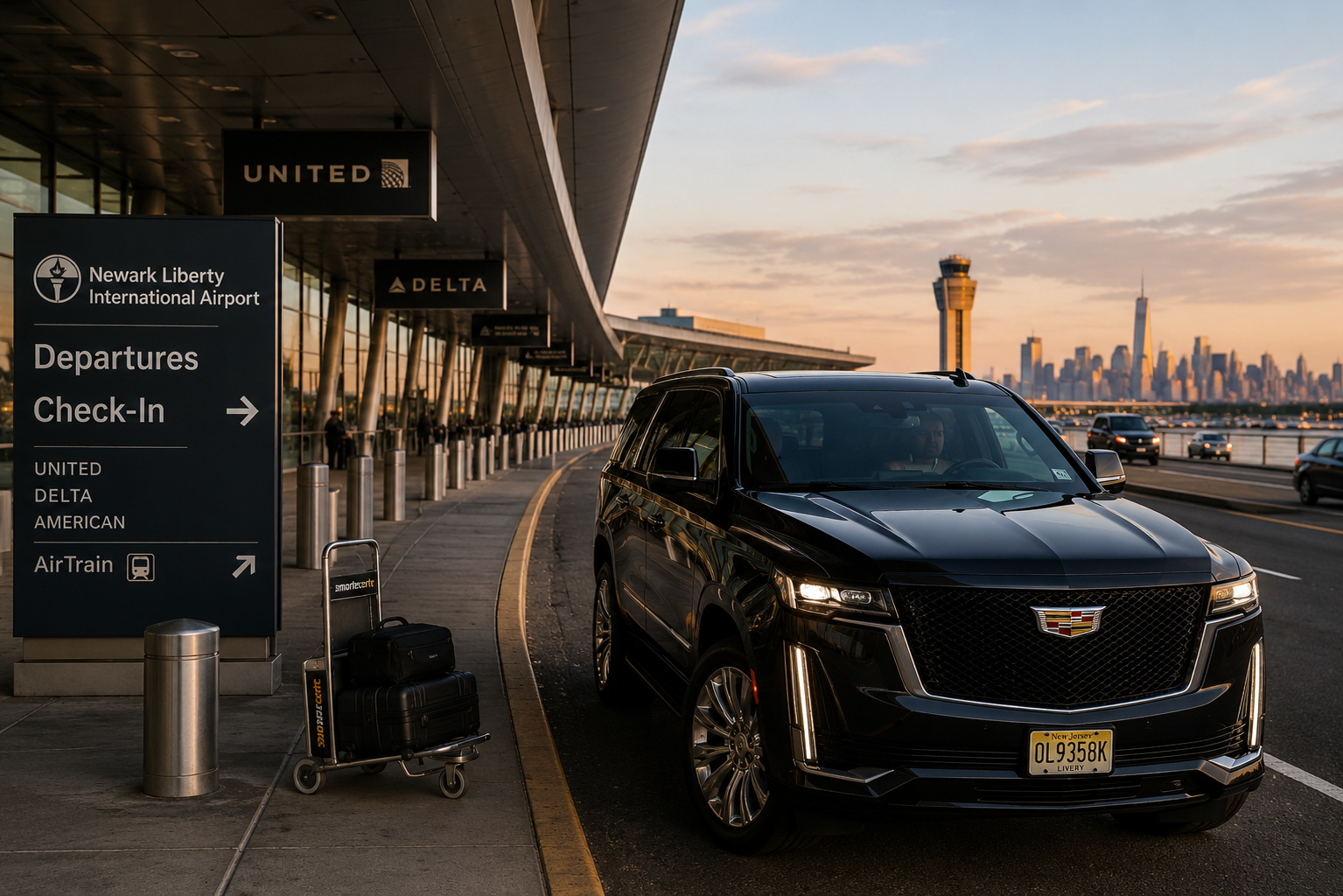
Newark Liberty International Airport can be one of the most convenient arrival points for Manhattan, northern New Jersey, Staten Island, and destinations throughout the metropolitan region. It can also require careful planning because the airport has three separate terminals, busy access roads, active loading areas, and travel routes that depend heavily on traffic.
For an executive traveler, airport pickup should not begin when the passenger reaches the curb. It should begin before the flight lands, with the correct terminal confirmed, the arrival monitored, the vehicle matched to the passenger and luggage, and a clear communication plan established.
This guide explains how to prepare for a Newark Airport pickup, what passengers should expect after landing, and how professional transportation can reduce confusion during the arrival process.
Newark Airport Pickup Essentials.
EWR has three terminals. Confirm the airline, flight number, arrival terminal, and any last-minute operational changes.
A scheduled landing time is not the same as the passenger’s curbside-ready time. Monitor the actual flight arrival.
Checked luggage, customs processing, walking distance, and terminal congestion can extend the arrival process.
The passenger and transportation coordinator should confirm the terminal, pickup area, and readiness before curb approach.
Preparation Begins Before Arrival.
A smooth Newark pickup depends on receiving complete reservation information. The airport and terminal alone are not enough.
The transportation provider should receive the airline, flight number, passenger name, mobile number, originating city, scheduled arrival, destination, luggage count, passenger count, and any special requirements.
- Passenger’s full name and mobile number
- Airline and complete flight number
- Originating airport or city
- Expected arrival date and time
- Final destination and additional stops
- Number and approximate size of bags
- Number of passengers traveling together
- Accessibility, child-seat, or mobility requirements
Flight numbers are especially important because arrival terminals and schedules can change. A flight arriving early, late, or at a different terminal can affect both the pickup plan and the driver’s approach to the airport.
Newark’s Three Passenger Terminals.
Newark Liberty International Airport operates with Terminals A, B, and C. Each terminal has its own roadway approach, arrival frontage, airline operations, and passenger flow.
Passengers should verify their terminal through their airline and airport information before arrival. The terminal associated with an airline is helpful, but the specific flight details should always control the final transportation plan.
A Modern Domestic Gateway
Terminal A is Newark’s newer terminal and serves a mixture of domestic and international carriers. Its roadways and parking facilities are physically separated from portions of the older terminal complex.
Passengers should follow the posted arrivals and ground transportation signs and remain in contact with their transportation provider before approaching the pickup area.
International Arrivals and Multiple Airlines
Terminal B handles numerous international services and flights operated by a broad range of carriers. International arrivals can require additional time for immigration, baggage claim, and customs processing.
Because processing time can vary considerably, the passenger should contact the transportation provider only after clearing the required arrival formalities and collecting all luggage.
A Major United Airlines Terminal
Terminal C is a significant United Airlines hub and can experience considerable passenger and vehicle activity. Travelers should carefully follow signs for their designated ground transportation method.
Pickup locations can differ depending on whether the passenger is using a prearranged professional vehicle, taxi, shuttle, or app-based rideshare service.
Airport pickup locations and roadway procedures can change because of construction, congestion, security operations, or temporary airport directives. Always follow current airport signs and instructions from authorized personnel.
How Newark Airport Pickup Works.
Airport curbs are intended for active loading and unloading. Vehicles generally cannot remain at terminal frontage while waiting for a passenger who is still inside the terminal.
The most effective method is for the vehicle to remain away from the active curb until the passenger has collected all belongings, reached the correct exit area, and confirmed readiness.
The Flight Is Monitored
The transportation provider reviews the actual arrival status rather than relying exclusively on the original scheduled time.
The Passenger Completes the Arrival Process
The passenger deplanes, walks through the terminal, retrieves checked bags, and clears customs when required.
The Pickup Point Is Confirmed
The passenger and driver confirm the terminal, level, exit area, identifying information, and any airport-specific instructions.
The Vehicle Approaches the Curb
Once the passenger is ready, the vehicle approaches the designated active loading area for an efficient pickup.
“The vehicle should approach the terminal when the passenger is ready—not while the passenger is still waiting for baggage.
Allow Additional Time for International Arrivals.
International arrival timing is less predictable than a simple flight-status notification may suggest. A flight can be marked as arrived while the passenger still needs to taxi to the gate, deplane, walk to immigration, complete inspection, retrieve bags, and pass through customs.
The amount of time required can vary based on passenger volume, staffing, passport status, baggage delivery, declarations, connecting flights, and whether additional inspection is needed.
Prepare the Transportation Provider
- Provide the international flight number
- Confirm the expected arrival terminal
- Include the passenger’s working mobile number
- Provide an alternate contact when appropriate
- Report unusually large or numerous bags
Contact the Driver When Ready
- Complete immigration processing
- Collect all checked luggage
- Clear customs inspection
- Proceed toward the appropriate public exit
- Confirm the pickup area before requesting approach
Select the Vehicle Before the Trip.
Passenger count alone does not determine the correct airport vehicle. Luggage size, carry-on bags, equipment, child seats, mobility devices, and passenger comfort must also be considered.
Premium sedan or executive SUV
Consider checked bags, garment bags, equipment, and the need for additional workspace or privacy.
Executive SUV
Confirm luggage quantity carefully, especially when each traveler has a full-size suitcase and carry-on.
Large SUV or passenger van
Include child seats, strollers, mobility items, and the size of all checked baggage in the reservation.
Multiple SUVs or executive van
A coordinated vehicle plan may be more effective than placing all passengers and baggage into a single vehicle.
Reserve for the luggage passengers will actually carry—not simply for the number of available passenger seats.
Plan for Variable Travel Times.
Newark Airport’s proximity to Manhattan can make it a practical choice, particularly for Lower Manhattan and parts of the West Side. However, the actual travel time depends on traffic, construction, weather, tunnel conditions, the terminal roadway, and the passenger’s final destination.
A trip that appears short on a map can become significantly longer during peak commuting periods, major events, holidays, roadway incidents, or severe weather.
Business and Hotel Districts
Route selection may involve the Lincoln Tunnel, Holland Tunnel, or another approach depending on the destination and current conditions.
Regional Corporate Travel
Newark can provide convenient access to Jersey City, Newark, Hoboken, the Meadowlands, and numerous New Jersey business destinations.
Brooklyn, Queens and the Bronx
Cross-city and bridge or tunnel travel can add substantial time, especially during weekday rush periods.
Regional and Interstate Destinations
Longer transfers should account for traffic, rest stops, passenger comfort, luggage requirements, and potential delays.
Planning for Business Travelers and Assistants.
Executive airport transportation is often arranged by an assistant, travel manager, law firm, financial institution, hotel, event planner, or corporate office. The person arranging the transportation may not be traveling with the passenger.
In these situations, the reservation should identify both the passenger and the coordinating contact. Each person should know who will receive updates and who should be contacted if the flight, destination, or passenger schedule changes.
Build a Complete Passenger Profile
Include the traveler’s correct mobile number, preferred name, destination contact, luggage expectations, vehicle preference, and any privacy or accessibility instructions.
Keep the Driver Informed
Notify the transportation provider when baggage is collected, when customs has been cleared, and when the passenger is approaching the designated pickup area.
Coordinate More Than One Vehicle
Divide passengers and luggage intentionally, establish a lead contact, and identify whether the group will travel together or proceed separately to different destinations.
Understanding the AirTrain and Ground Connections.
Newark’s AirTrain connects airport facilities, parking areas, and the Newark Liberty International Airport rail station. Travelers using public transportation can connect with rail service at the airport station.
Terminal A is not directly connected in exactly the same manner as Terminals B and C, so travelers should follow current airport instructions for walking or shuttle connections where required.
Hotel shuttle arrangements and airport construction procedures may also change. Travelers should verify the current designated pickup station before leaving the terminal.
Newark Airport Pickup Checklist.
A Better Newark Arrival Is Built on Preparation, Timing and Communication.
Newark Liberty International Airport can provide efficient access to both New Jersey and New York City, but the experience depends on planning beyond the scheduled landing time.
Confirm the flight, understand the terminal, allow time for baggage and customs, select the right vehicle, and communicate before the vehicle approaches the curb.